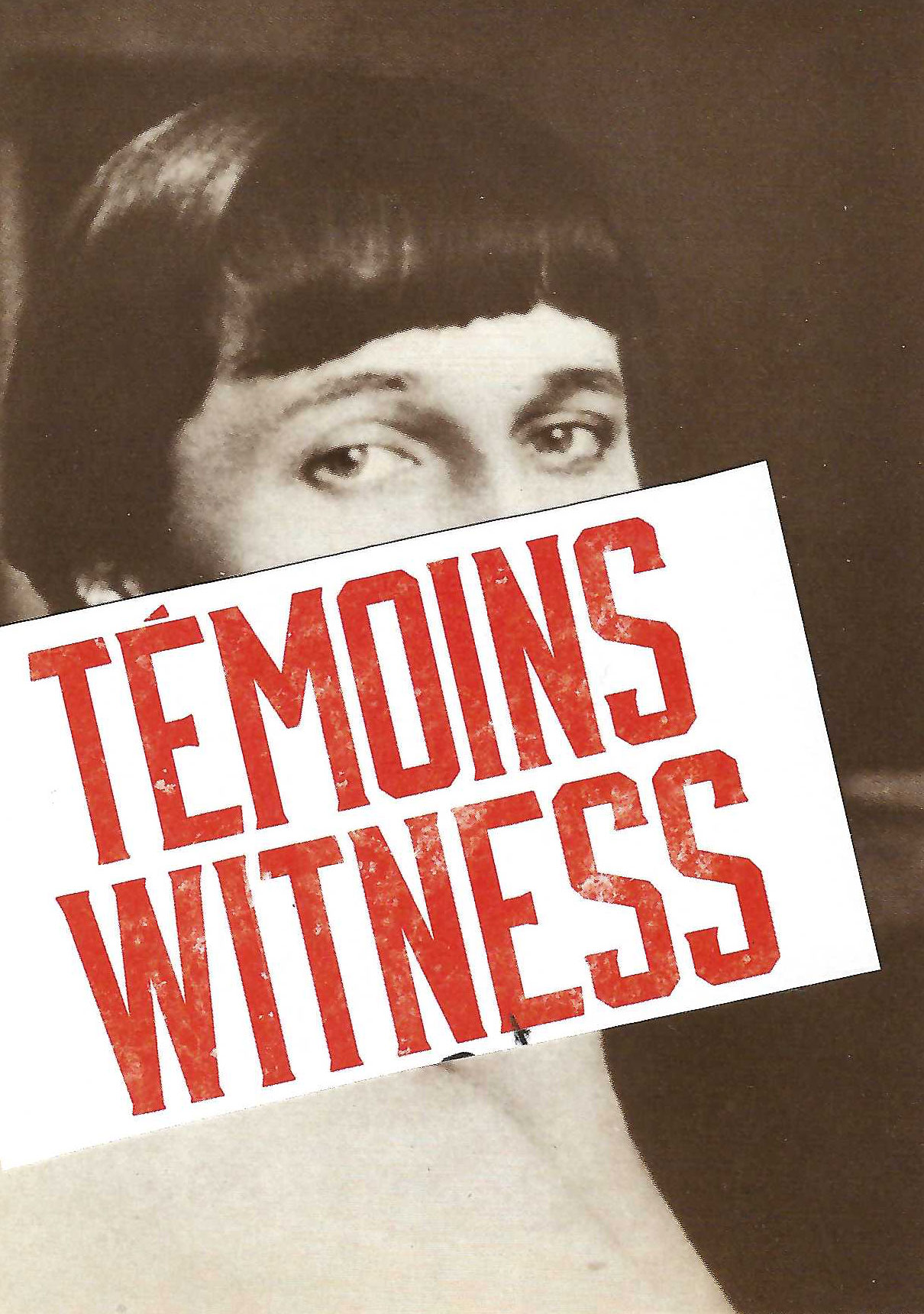
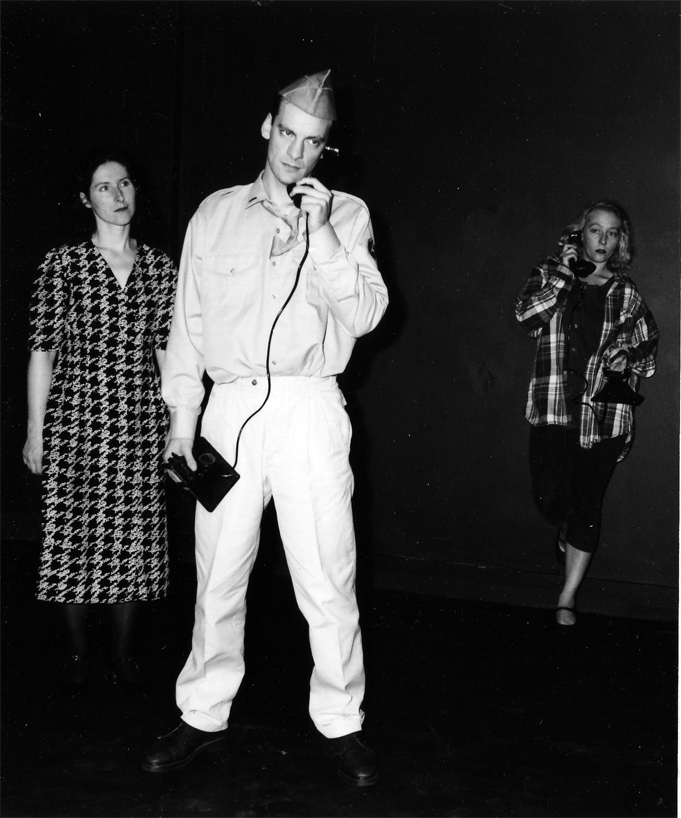
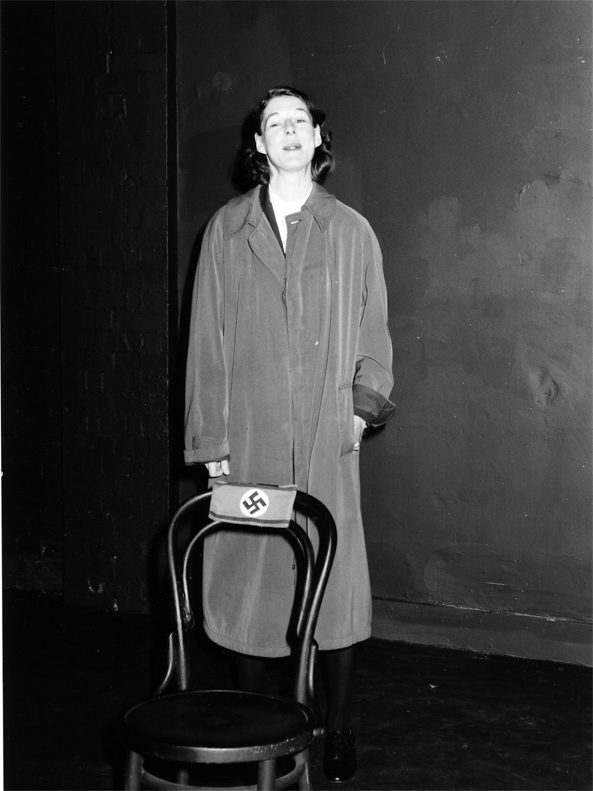
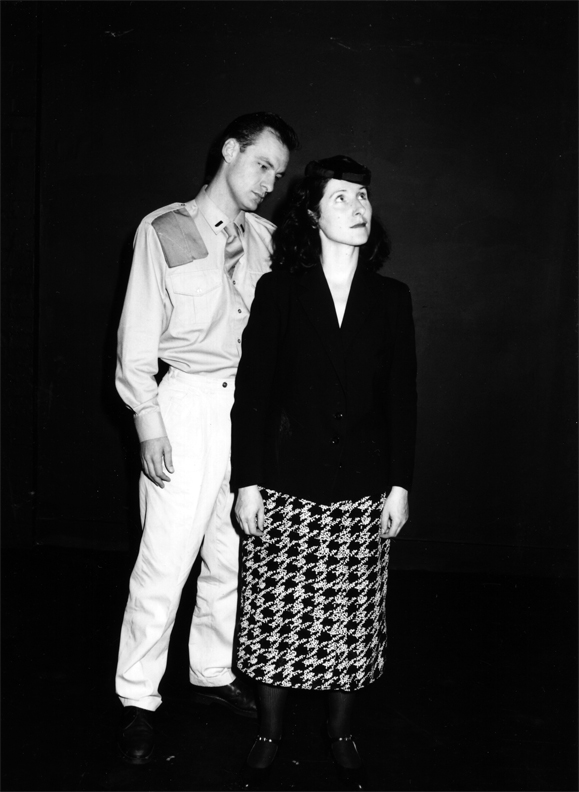
The Nazis, wrote Primo Levi, called a Jew in a concentration camp “a dead man on holiday.”
A Dead Woman on Holiday occurs not in a concentration camp but during the Nuremberg Trials after the War. Sophie Goldenberg, a French Jew, is working as a translator during the hearings when she and a Catholic American soldier meet and fall in love. But she has an English husband, and he an American wife and child.
Addressing issues such as adultery, guilt and survival, it contrasts a conventional marriage and domesticity against free love.
3 women, 2 men.
(PAUL and SOPHIA move towards an embrace.
Music linking scenes. Bach’s Concerto for Two Violins in D
Minor, Vivace and Largo ma non Tanto.)
Scene. LA RENCONTRE / THE MEETING
GERMAN VOICE
Today we pronounce sentence on:
(Gives the names of the men on trial.)
Hermann Wilhelm Göring, Rudolf Hess, Joachim von Ribbentrop, Robert Ley, Wilhelm Keitel, Ernst Kaltenbrunner, Alfred Rosenberg, Hans Frank, Wilhelm Frick, Julius Streicher, Walter Funk, Hjalmar Schacht, Karl Doentiz, Erich Raeder, Baldur von Schirach, Fritz Sauckel, Alfred Jodl, Martin Bormann, Franz von Papen, Arthur Seyss-Inquart, Alfred Speer, Constantin von Neurath, Hans Fritzsche.
Crossfade as PAUL exits, leaving SOPHIA and DEE DEE.
DEE DEE
I’m Mrs Paul Carver.
SOPHIA
Sophia Goldenberg.
DEE DEE
I’m so glad to meet you. I know you are important in my husband’s life.
SOPHIA
Oh yes?
DEE DEE
Shall I tell you how we met?
SOPHIA
I don’t want to hear.
DEE DEE
I see.
SOPHIA
What do you see?
DEE DEE
I have two small children. Suzanne is fi ve years old. She has blonde curly hair and large blue eyes. When she was being born, they thought I would die. She seemed to get stuck. Her birth was a terrible agony. When she arrived her face was battered, her nose was swollen, she looked as if she’d been in a fight. Paul was with me through the labour, he held my hand, and when I thought I was going to die, I looked up at him and I thought that as long as Paul was with me, I didn’t care if I died bearing his child. He was with me, you see, that was all that was important. Suzanne is a very precious child, you know, she nearly killed me, loving Paul nearly killed me.
SOPHIA
But you lived, didn’t you?
DEE DEE
Do you understand what I’m telling you?
SOPHIA
You lived. Do you know how many women died before they knew what love is?
DEE DEE
I’m sorry. Did you have a family who…
SOPHIA
were killed by the Nazis? You can say the words, you know.
DEE DEE
I’m sorry, I didn’t mean to be insensitive.
SOPHIA
You think it’s insensitive, you think anything you can say can hurt me?
DEE DEE
I don’t know. I know it’s different over here in Europe. I know you suffered in a way that we never knew, but I read about it.
SOPHIA
You read about it.
DEE DEE
Did your family die that way?
SOPHIA
You mean gassed in Auschwitz or Treblinka?
DEE DEE
Yes.
SOPHIA
No, they put a bullet through their heads.
DEE DEE
Please. I have two small children.
SOPHIA
And I have none.
DEE DEE
But you have something which holds him the way I can’t. I can see why he loves you.
SOPHIA
What do you see?
DEE DEE
I see a beautiful, intelligent woman who has suffered.
SOPHIA
Don’t patronise me.
DEE DEE
I didn’t mean to. I’m trying to understand, can’t you see that? He’s all I ever had in my life… You, you’ve got your career, you’re attractive, you have no children, men like you, you could have whoever you want. Go away, find someone else, leave him, let him go.
SOPHIA
You know what strikes me? It’s the thought of all those dead young women who will never have the pleasure of watching a lover grow old. Who will never see the man they love at forty, at fifty, at sixty. Will never see his firm skin gradually turn to fine pleats. Will never experience the sweet, sweet sensation of loving that skin year after year. Or watching a lover in the bath and washing him all over as if that soft-skinned, soapy man were her own child. Will never have the pleasure of being a young girl still, under her own mature skin. Or stretching a hand out under the sheets and knowing that she’s chosen this man of all men; this man to cherish in the dark nights when hell is outside. I don’t think of the youth that was stolen. I think of the lost joy of growing old, of the possibility of love in age. Of loving someone whose hair is grey and seeing the boy of eighteen in the man of sixty or seventy. That’s what I miss when I think of Dachau. Or Auschwitz.
DEE DEE
Let me have him back.
ENDS
A Dead Woman on Holiday is part of The Holocaust Trilogy by Julia Pascal available to purchase from Bloomsbury.
Production History
27 January 2025 Staged reading of A Dead Woman on Holiday performed at Burgh House, Hampstead to mark the 80th anniversary of the liberation of Auschwitz.
1994 Premiere at Holborn Centre for Performing Arts
This modern prose play is so organized in time and space that it acquires the kind of austere beauty and rhetorical tension we associate with the tragedies of Racine. The Financial Times
Background
A Dead Woman on Holiday reveals what happened to those who were the interpreters at the Nuremberg Trials. The Trials were created by the British, French and Russian interrogation of some of the Nazi perpetrators to bring them to justice before the world. The drama explores the experience of Sophia Goldenberg, a French Jew who worked for the British during the war and who was asked by the British to be one of the many interpreters at the Trials in 1945. The intensity of simultaneous translation took its toll on the interpreters. Many had mental breakdowns as transmitters of witness and at the stress of revealing the Nazis’ actions. The interpreters were the conduit between the perpetrators and the victims. As a result of the burden of what they had to transmit, many could no longer remain in their marriages. The Trials were not merely a job but a life-changing experience. Many marriages were destroyed. The evidence had to be made public through the skills of the interpreters but they also paid a price.
I wrote A Dead Woman on Holiday in 1991 after spending time in the Imperial War Museum examining footage from the Trials. I say the footage but, in fact, the film stock, which was over 50 years old, was degraded. Images and speeches were fragmented. Evidence came in isolated jump cuts. This made me realise that what I was seeing; isolated words and testimony, faces that mouthed what no person should see; paralleled how unbearable memories remain. Memory, and in this case film archive, comes in shards. Realising this helped me construct the play’s structure. It mixed the personal with the professional. The text is a mosaic of Trial evidence and a means of showing how humans break down as a result of bearing witness. The acute nature of the job meant that interpreters could only bear to work for an average of three to six months at a time. Turnover was great. The interpreters felt crucial in this first public war crimes tribunal. They became a kind of Greek chorus transmitting a message from Hell to the liberated world. They knew that the words they were interpreting were being heard on the world stage.
Watching the Trial films and reading testimony was my primary research and this helped me get the atmosphere of witnesses but I needed a central focus to engage the audience. This was the central character of Sophia Goldenberg as the major interpreter within the drama. The character is a kind of metaphor. She represents those who have gone through second generation trauma rather than the person who has had direct experience. Sophia Goldenberg was not murdered but, at the start of the play, she carries the weight of survival. In the first scene the audience learns that her parents, French Jews, chose to shoot themselves rather than be taken by the Nazis.
It was important to me that the central war figure be female: most war dramas focus on male experience. This text is a deliberate attempt to produce dramatic literature for the canon which uncovers a woman’s experience of war. Questions around love and sexuality are also present in the narrative as a way of asking if it is possible to love when someone has been emotionally damaged after escaping Hitler. Within the story, Sophia Goldenberg engages with another interpreter, the American, German-speaking interpreter, Vincent Wilding. Both are married to others but both want to be together. The drama explores questions around marriage itself: should it be domestic or a new kind of partnership. It also looks at the experience of how some Americans were changed by entering the European theatre of war. Much of this area was inspired by meeting Martha Gellhorn who had been at the Trials. She spoke to me about what she had seen and heard. Children of Black American soldiers told me how their fathers had been traumatised when they entered Dachau. My research was wide and helped me gain some knowledge of what the witnesses had felt when they saw the nightmare of the ‘Aryan Dream’.
This is what I saw and heard but there was more in the Imperial War Museum archive that I was not allowed to see. Custodians told me that images that were considered too distressing were those of British soldiers vomiting as they discovered the dead and the living dead. It was ‘too unbearable to be shown.’
The play-reading showed me that this drama still has tremendous power. It pays tribute to the interpreters who allowed this evidence to pass through their brains and into their memories even if it meant that they would be changed forever.
Julia Pascal
© 2026 Julia Pascal. This play is protected by copyright law. This piece may not be fed into any LLM or other AI software for any reason. By downloading this script, you agree not to upload it to Scribd or similar websites. No part of this script (or any other scripts found on the New Play Exchange, my website, or the internet) may be uploaded to and/or used to train artificial intelligence chatbots, systems, applications and the like.